
February 12, 2027EMDR Therapy for Caregiver Burnout in Escondido
You're the Caregiver who is on 24/7...
If you're the person everyone leans on, and getting through the day takes everything you have, this page is for you.
Caregiver resentment isn't a character flaw — it's what happens when your nervous system gets stuck in survival mode with no relief, and your brain starts associating the person you care for with chronic stress and lost autonomy. Even when you love them.
Maybe you're a parent of a disabled child. Maybe you're sandwiched between caring for your kids and your aging parents. Maybe you're a mom running the day alone, work demands, solo or single parenthood, widowhood, and no backup.
Kelli has worked with all of these. As a wife and mother of two, she navigated long stretches of parenting alone while getting a PTSD diagnosis of her own — and one for her daughter. She knows what caregiving demands of you in the moment you want to run away. It's personal for her in other ways too: her own brother was medically fragile for part of her childhood, and she's walked alongside friends navigating meal trains and medical crises of their own.
First-hand experience counts when you're looking for someone who gets it.
EMDR with Kelli offers somatic EMDR therapy for caregiver burnout in Escondido and across North County San Diego — helping your nervous system come out of survival mode so you can feel like yourself again.
Below are some sneaky symptoms.
❋ You might notice it as a short fuse over small things.❋ Excessive Guilt for Resting ❋ A body that feels heavy and wired at the same time - hypervigilance❋ Resentment and Shame about ResentmentTwo Things Are True at the Same time:
You can love someone deeply and resent what caregiving has required of you.
You can be grateful for your life and still feel completely exhausted by it.
You can want to care for someone and desperately want a break.
You can be high-functioning and not be okay.
You can know you need rest and still feel guilty taking it.
You can be surrounded by people and feel completely alone in caregiving.
You can know your loved one isn't to blame and still feel angry.
The trick is in the feeling that comes after…
“What kind of mom/daughter/son/dad thinks like that.”
You may not be to the point yet where you’re ready to treat the caregiving burden. You’re still at the stage of “why am I like this, and are other people like this?”
The answer is yes, and the name is caregiver burnout.
When the brain associates between the loved one and the unrelenting demand, the connection becomes something you may feel avoidance towards, out of survival. You still need to care for them, but now it’s at a cost to your authenticity.
With caregiving, a grief of lost identity/freedom, for yourself and loved one needs to be named to be felt.
Most importantly, the shame cycle intensifies any feelings that are not “I love them so much and I love taking care of them 24/7.” That’s just society’s narratives about “in sickness and health” and “be the good daughter/son.” But it wears people down, especially if they allow shame to define who they are because of their thoughts.
But WHY do I feel resentment?
Wouldn’t it be nice if you could take a break, like everyone tells you to?
What is Caregiver Burnout?
You know it’s likely unrealistic to get away for a couple hours, much less regularly look after yourself.
Caregiver burnout is the physical, emotional, and mental exhaustion that builds when you give more care than you get back, for a long stretch, with no real break. The Cleveland Clinic describes caregiver burnout as a state of depletion that can bring on changes in sleep, appetite, mood, and health.
Many caregivers experiencing burnout keep functioning on the outside while feeling hollowed out on the inside. That gap is real, and it is treatable.

Some Questions You’re Likely Googling/Searching on AI:
-
A few sessions with EMDR can help you determine the way forward. Kelli can guide you to help answer this questions with clinical knowledge.
-
Somatic practice can help you reconnect to your joy and individual purpose, to authentically care for your family members.
-
The answer is yes, let me teach you some regulating tools for the in the moment changing from anxious to regulated.
-
This might be the number one thing I hear from Clients when they are in the throws of caregiving. The edge is a messenger, are you listening to the message?
-
The short answer is conditioned hypervigilance in your body. But there might be more, with medically complex families, there is a possibility of grief, PTSD, medical trauma, and other uncertain feelings. It’s a lot to hold and when you finally try to rest, it’s where your mind goes.
Caregiver Burnout FAQs
How does somatic EMDR therapy help caregivers experiencing burnout?
Somatic EMDR therapy works on the exhausted, always-on nervous system underneath the tiredness, not just the schedule that wore you down. Burnout tends to leave your body stuck between collapse and constant alarm, and no amount of sleep resets that on its own.
EMDR helps your brain reprocess the beliefs that keep you running. Beliefs like "I have to keep going," or "if I stop, everything falls apart." Through the work, your system gets to learn, through direct experience, that stopping is not a threat.
The somatic part means we pay attention to what your body is doing while we work. The tight chest. The clenched jaw. The urge to keep moving even when you're sitting still. We slow down and let your body finish what it never got to release.
What is the difference between weekly EMDR sessions and a somatic EMDR intensive?
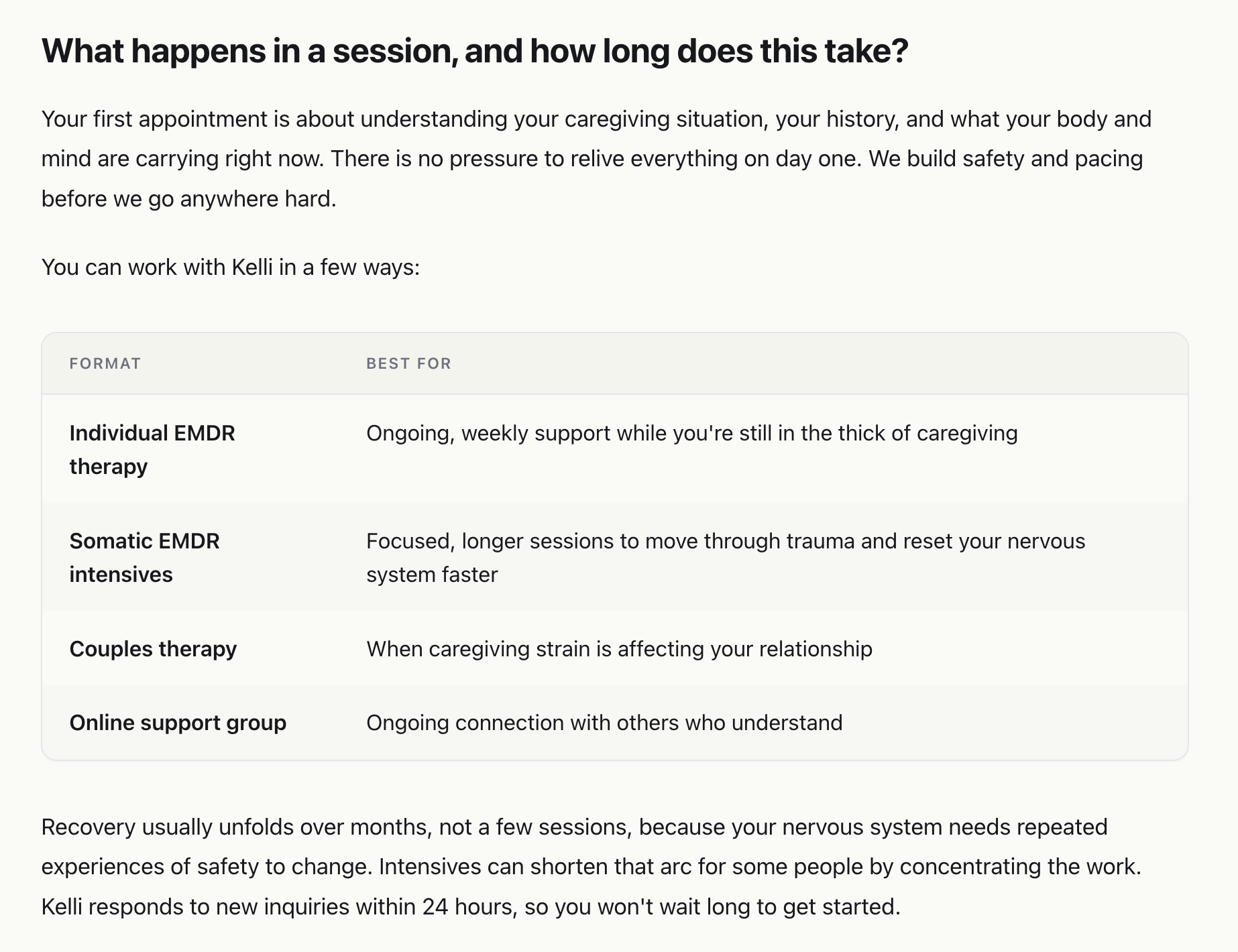
Weekly individual EMDR therapy gives you steady, ongoing support while you're still caregiving day to day. A somatic EMDR intensive concentrates the work into longer, focused sessions, which can help you move through trauma and settle your nervous system in a shorter timeframe. Kelli can help you decide which fits your situation during your first conversation.
What does it cost and how do you pay?
Fees depend on whether you're doing weekly individual therapy or a somatic EMDR intensive. Somatic EMDR costs $300/hr, 2-4 hours, or $2000 for a Full Day - 6 hour intensive.
Payment is accepted by cash, card, check, Zelle, and Venmo. Payment plans are available if paying in full at once isn't workable for you right now.
How do I book?
Call or text 949-630-8776, or reach out through the contact page at emdrwithkelli.com/contact-kelli. Kelli replies to new inquiries within 24 hours, and the first message is just a conversation, not a commitment.
If you've been putting your own care at the bottom of the list for years, booking that first appointment is the step that starts to change it.
Who is Kelli, and where does she work?
Kelli is a Licensed Marriage and Family Therapist in California (LMFT, CA #158231) who focuses on trauma, PTSD, CPTSD, OCD, anxiety, perimenopause, and relationship difficulties. Caregivers experiencing burnout sit squarely inside that work, because burnout so often lives on top of older trauma and the belief that your needs come last.
She serves Escondido and the surrounding North County San Diego communities, including Del Mar, Solana Beach, San Marcos, Vista, Valley Center, Poway, Rancho Bernardo, Carlsbad, and Bonsal. As a California-licensed therapist, she can also work with anyone located in California by secure video.
EMDR with Kelli has been serving clients in San Diego for 4 years with a practice built specifically around somatic and EMDR approaches to trauma, OCD/phobias, stress, PTSD, and caregiver burnout, rather than general talk therapy.
How soon can I get an appointment as a caregiver experiencing burnout?
Kelli responds to new inquiries within 24 hours. From there, you'll schedule a first session based on your availability, which matters when your days are already stretched around someone else's needs.
Tell Me More About Your Experience with Caregiver Burnout

Dive in, level up, and leave stronger than when you arrived.
About
Kelli Redfield, LMFT
California Licensed Marriage and Family Therapist #158231
Since 2020, for 6 years, I have been helping women and individuals with a trauma informed lens; as a Somatic EMDR therapist specialising in CPTSD, trauma recovery, OCD, nervous system regulation, difficult relationships, burnout, and attachment wounds in San Diego California.
MA in Clinical Psychology from Pepperdine University in 2023.
Associate Therapist 2023-2025
Relational Life Therapy - Level 1 - 2023
Somatic Integration in Trauma Therapy - 2024
EMDR Basic Training - 2025
Licensed Marriage and Family Therapist - Sept 2025
EMDR Certification Supervision 2026
ERP in EMDR OCD/Phobias training - 2026
Clinical Hormone in Mental Health Training - 2026
I have extensive experience with EMDR in sessions and continuing education in ERP in EMDR, Perimenopause and Menopause transitions, co-regulating somatic touch, and somatic integration.
I can be found in the EMDRIA directory and on Psychology Today and Instagram.